Reservoir Books
Jacques Ozanam – L’Usage du Compas de Proportion – Paris, 1700 – Erwin Tomash Copy
Jacques Ozanam – L’Usage du Compas de Proportion – Paris, 1700 – Erwin Tomash Copy
Couldn't load pickup availability
OZANAM, Jacques. L’Usage du Compas de Proportion, expliqué et demontré d’une maniere courte & facile, & augmenté d’un Traité de la division des Champs. Nouvelle édition, corrigée & augmentée. Paris: Jean Jombert, 1700.
Third edition of Jacques Ozanam’s practical treatise on the compas de proportion, or sector: an important seventeenth-century mathematical calculating instrument used for proportional, geometrical and related calculations.
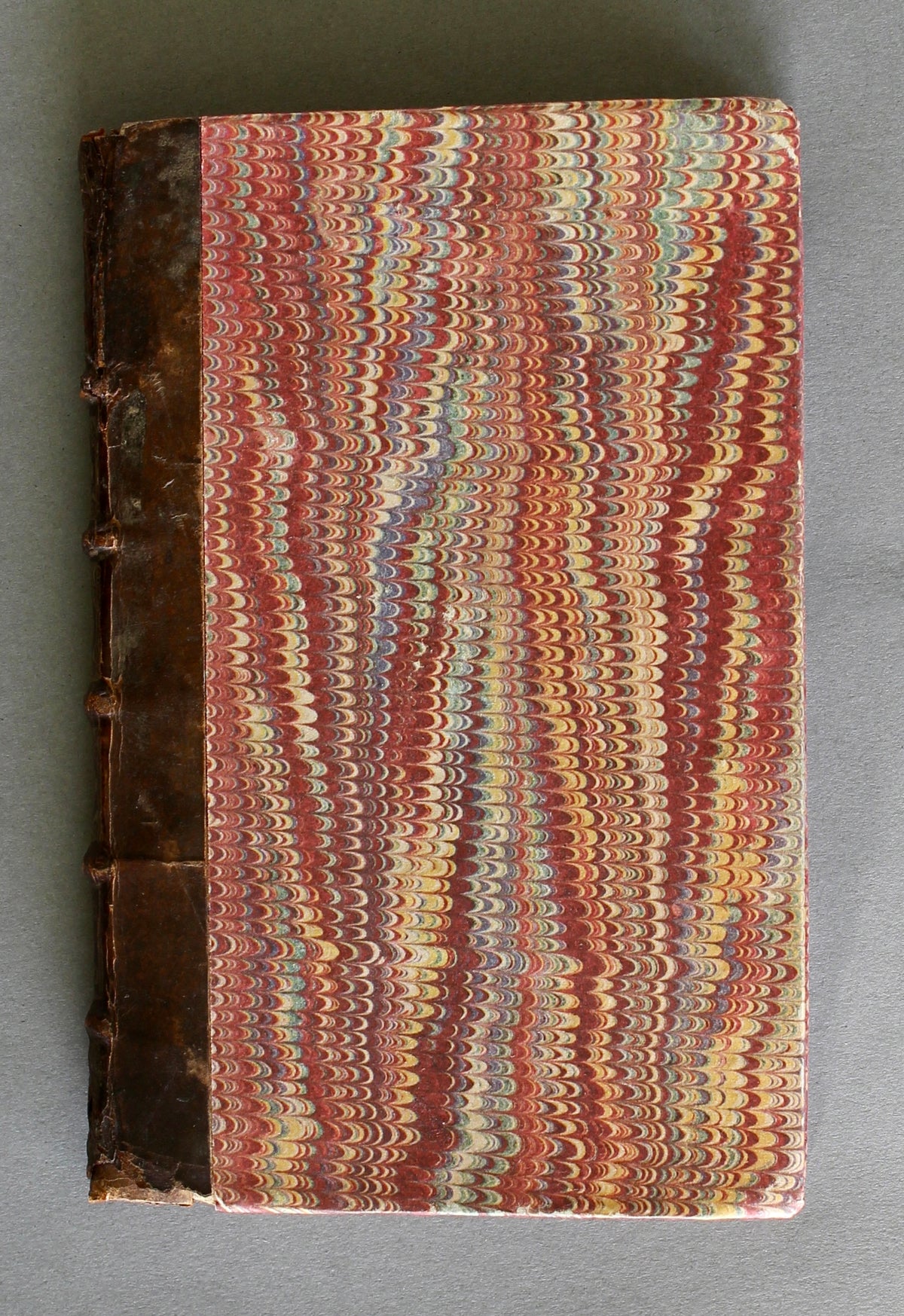
8vo, pp. 139, [5]. Two engraved plates illustrating the proportional compass, woodcut initials, head- and tail-pieces, numerous geometrical diagrams and tables in the text. Twentieth-century marbled boards retaining an earlier calf spine now heavily rubbed, with wear and loss at head and foot; previous repairs to the spine ends are visible.
Ozanam explains the construction and use of the proportional compass and its various graduated scales, including those for equal parts, polygons, planes, solids and chords. The latter portion of the book is devoted to geometrical problems concerning the division of fields, illustrated throughout with practical diagrams.
The sector was one of the principal mathematical instruments of the seventeenth century, allowing calculations to be carried out mechanically by means of proportional scales. Its applications extended to mathematics, surveying, engineering and military practice, placing works such as Ozanam’s firmly within the prehistory of mechanical and analogue computation.
The work was first published in Paris in 1688. This 1700 edition, described on the title page as a Nouvelle édition, corrigée & augmentée, is the third edition and the second published in Paris.
Provenance
A. Schmidt, ownership inscription dated 1804 to the title page.
Bibliothek der TU Dresden, institutional stamp dated 16 December 1955.
Erwin Tomash (1921–2012), green ownership label to the front pastedown. Tomash was a pioneer of the computer industry, a founder of the Charles Babbage Institute, and the creator of one of the outstanding private libraries devoted to the history of computing and calculating technology. His collection ultimately comprised thousands of books and manuscripts documenting mathematics, computation and calculating instruments from the Renaissance onwards.
This edition is recorded as Tomash & Williams O71 in The Erwin Tomash Library on the History of Computing: An Annotated and Illustrated Catalog.
A particularly appropriate provenance for a seventeenth-century manual devoted to an early analogue calculating instrument.
Condition
Contemporary binding worn but substantially intact. Leather rubbed with surface loss, particularly at the head and foot of the spine and along the joints; corners and extremities worn. Gilt tooling remains clearly visible. Marbled paper to boards rubbed at the edges. Boards remain attached.
Title page browned and somewhat soiled, with creasing and several earlier ownership or institutional markings inked over; the manuscript ownership inscription dated 1804 remains visible. TU Dresden library stamp internally. Occasional light browning, staining, handling marks and marginal creasing elsewhere.
Two leaves with marginal tears, neither affecting printed text. A faint tide mark to the upper margin affects approx 6 later leaves, again without loss of interference with the text or diagrams.
Textually complete, with pp. 139, [5], the engraved Chapotot proportional-compass illustration, numerous geometrical diagrams and tables, and terminal publisher’s advertisements.
A well-used but complete copy, considerably enhanced by its provenance from the Erwin Tomash Library on the History of Computing.
References
Tomash & Williams O71; Dictionary of Scientific Biography X, pp. 263–265.
Share