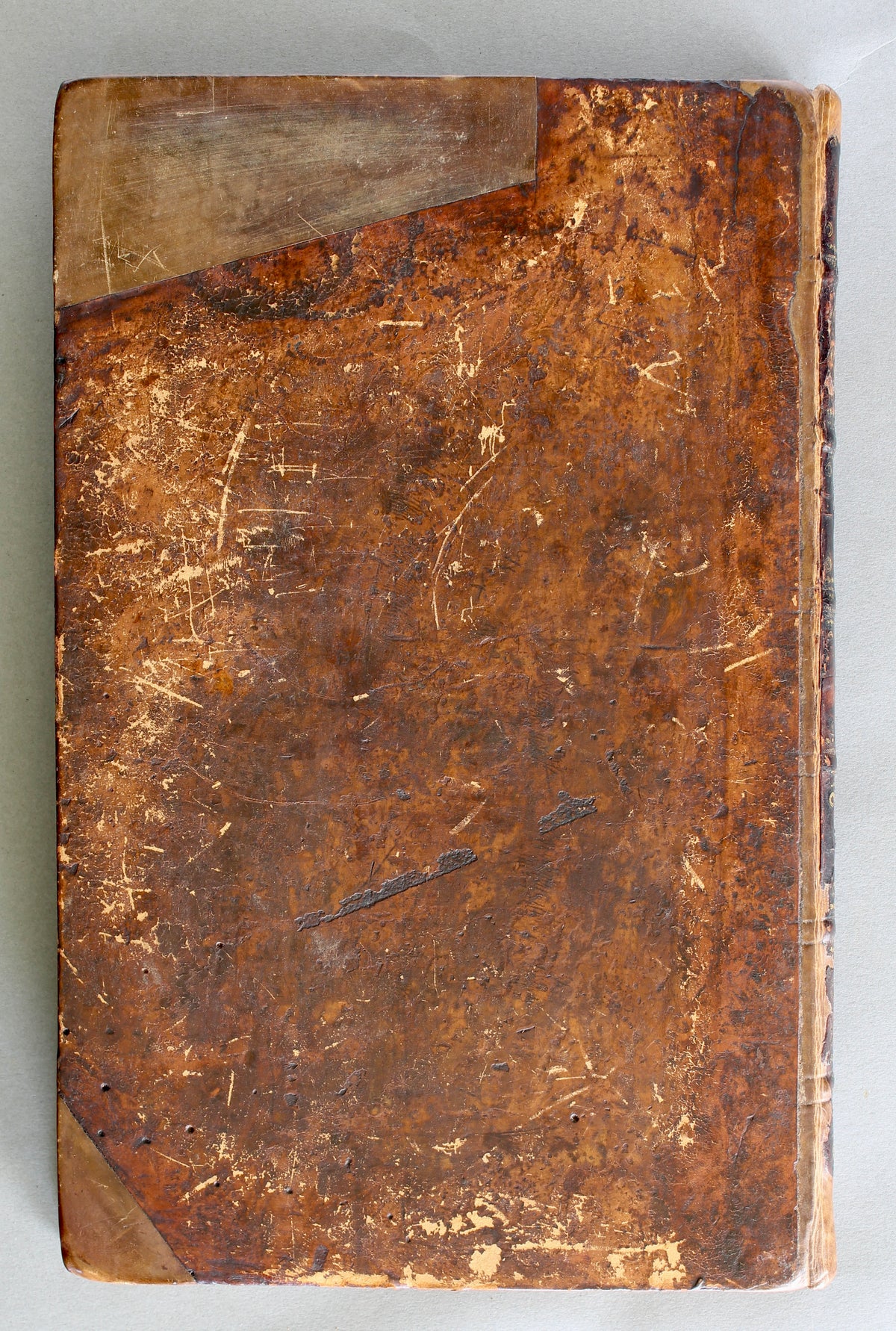
BROWNE, John. A Compleat Treatise of the Muscles, As they appear in Humane Body, And arise in Dissection; With Diverse Anatomical Observations Not yet Discover’d. Illustrated by near Fourty Copper-Plates, Accurately Delineated and Engraven. In the Savoy: Printed by Tho. Newcombe for the Author, 1681. First edition. Folio, approximately 32 × 21 cm.
An incomplete copy, retaining 33 of the required 37 numbered anatomical plates. Plates V, VIII, XII and XVI and the engraved portrait frontispiece are lacking. Extensively repaired; text complete.
An important and strikingly illustrated Restoration-period anatomical work by John Browne, surgeon in ordinary to Charles II, with a celebrated series of large copper-engraved anatomical plates. The engravings range from detailed studies of individual muscles, hands, feet, head, pelvis and limbs to dramatic full-length anatomical figures posed as if living within classical landscapes. The work was substantially revised and reissued from 1684 under the title Myographia Nova.
Browne’s work also occupies a notorious place in the history of anatomical publishing. Much of the text was derived from William Molins’ Myskotomia, while the illustrations were based on the anatomical plates of Giulio Casserio. Browne was subsequently attacked for plagiarism by the surgeon James Young. Nonethless, the work proved popular, appearing in ten editions in English, Latin and German.
Subscribers include the natural philosopher Robert Boyle, physician and author Sir Thomas Browne, mathematician John Wallis and leading physicians including Sir Charles Scarburgh, Edmund King, Walter Needham, Edward Browne and William Briggs.
The work belongs firmly to the practical world of Restoration surgery as well as to the history of anatomical illustration. Browne’s later revised edition described its anatomical method as being in general use at the theatre of Chirurgeons’ Hall, where surgeons received formal anatomical instruction.
Collation and plates
[30], 1–60, 63–66, 66–70, 70–76, 76–80, 80, 80, 82–86, 86–90, 90–96, 96–98, 98–102, 102–108, 108–112, 115, 144, 114–192, 163, 194–204, 204–213 pp.
The text ends at p. 213; the highly irregular contemporary pagination represents 237 actual pages. Signature Q and the nominal pp. 61–62 are absent as issued, the text proceeding correctly from p. 60 to p. 63. Text complete.
33 original numbered engraved anatomical plates present, of 37 required. Plates V, VIII, XII and XVI are lacking, as is the engraved portrait frontispiece.
No obvious surviving stub or clear evidence of excision is reported at the positions of plates V, VIII and XVI; these may have been absent when the volume was rebound. Plate XII has been roughly removed, leaving a torn remnant at the gutter. The missing plate illustrated the muscles of the male genital and perineal region, including the erector penis, accelerator penis, levatores ani and sphincter ani. This plate is commonly missing.
Despite these losses, the volume retains the majority of its original engraved suite, including many of the most visually impressive full-page anatomical figures.
Binding and provenance
Early speckled calf, heavily worn and rubbed; rebacked at an earlier date with much of the original gilt-decorated spine laid down. Corners repaired. Later plain endpapers. Early manuscript ownership inscription of Thomas Smith within the volume.
Condition
A heavily used and extensively repaired copy. Binding heavily rubbed and worn, with surface loss, scratches and abrasions; earlier reback and repaired corners, remaining sound and stable.
General age-toning, spotting and staining throughout, some leaves substantially stained. Numerous old paper repairs to tears, weaknesses and losses in both text leaves and plates; some repairs extend into printed or engraved areas, generally without substantial loss of content. Several plates have repaired tears and creases. Plate XIII has a long diagonal tear. The terminal index leaf has a very long repaired tear through its lower portion. Title page worn, stained and annotated in manuscript. Occasional marginal tears, handling marks and soiling throughout.
A defective but substantially preserved and visually compelling example of late seventeenth-century English anatomical publishing.
References
Wing B5126; ESTC R20507; Cushing B762; Russell 101; Wellcome III, p.251; Heirs of Hippocrates 642; Krivatsy 1820.